
There are over 86,000 active Red Notices circulating through Interpol’s system right now, and the public can see less than 10% of them.
Interpol’s Red Notice is supposed to be a global law enforcement tool, helping police across 196 countries catch serious criminals: murderers, traffickers, war criminals. And yes, it does that job.
But there is a version of this system that nobody in power wants to talk about too loudly: authoritarian governments using it as a political weapon to hunt their own critics across international borders.
It’s documented, ongoing, and as of 2026, it’s getting worse in some ways, even as Interpol tries to fix it.
What Is an Interpol Red Notice, Really?

When I first heard “Red Notice,” I thought it was an international arrest warrant. But it is not, technically.
Interpol’s own rules describe it as a request to law enforcement worldwide to locate and provisionally arrest a person pending extradition. But the arrest warrant itself comes from the requesting country, so Interpol just broadcasts it globally.
However, one thing that makes it really complicated is that about a third of Interpol’s member countries treat a Red Notice as if it’s an arrest warrant.
So when someone with an active Red Notice crosses a border in one of those countries, they can be detained immediately, and there won’t be any trial or proper hearing, and soon the requesting country’s extradition process kicks in.
Though Interpol says it’s not an arrest warrant, in practice it functions like one across dozens of jurisdictions for hundreds of millions of people.
How Does Interpol Red Notice Work
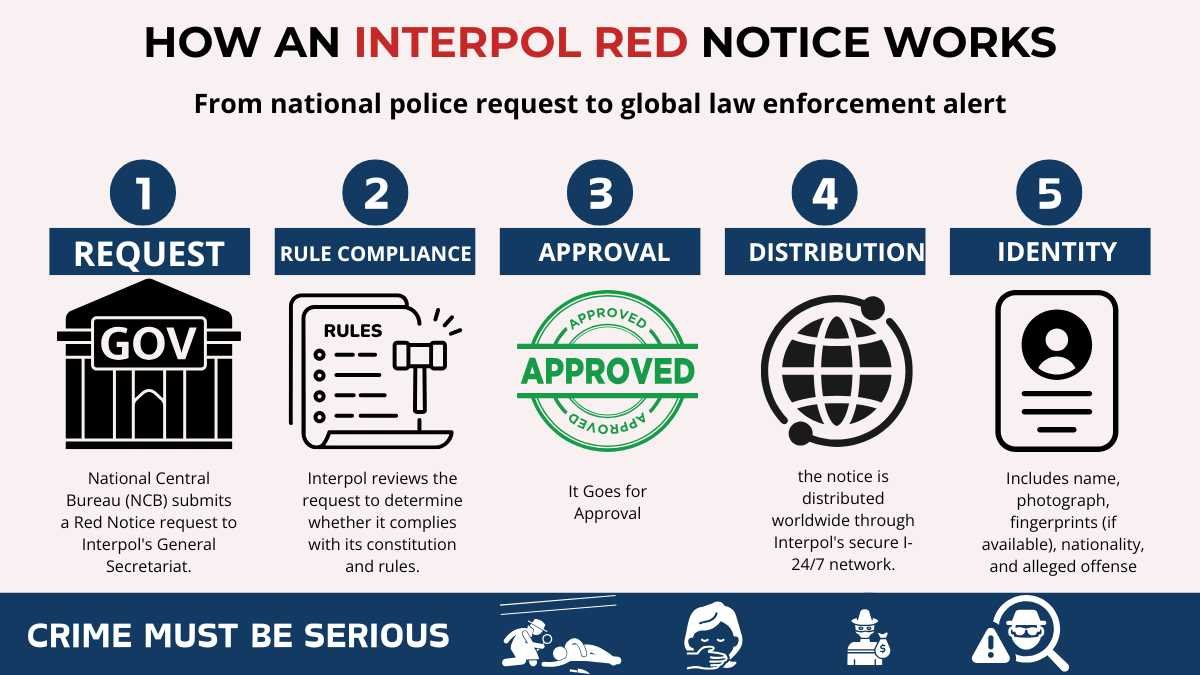
- Request: A member country’s national police agency (called a National Central Bureau, or NCB) submits a request to Interpol’s General Secretariat.
- Rule Compliance: Interpol’s internal compliance team reviews it against its rules.
- Approval: If approved, it goes out to all member states via their secure I-24/7 network.
- Person Identity: The notice contains the person’s identity details (name, photo, fingerprints if available) and the alleged crime they’re wanted for.
- Crime Must be Serious: Interpol’s rules say the crime must be a serious ordinary-law offense: murder, rape, armed robbery, fraud. It can’t be something like non-traffic violations or political criticism.
The loophole that every abusive government has figured out: frame the political opposition charge as a criminal one. Corruption, Fraud, Money laundering, Terrorism, etc.
These labels are easy to attach to anyone a regime wants to silence, and they’re hard to immediately disprove across international borders.
Understand the Story with Numbers of Red Notices
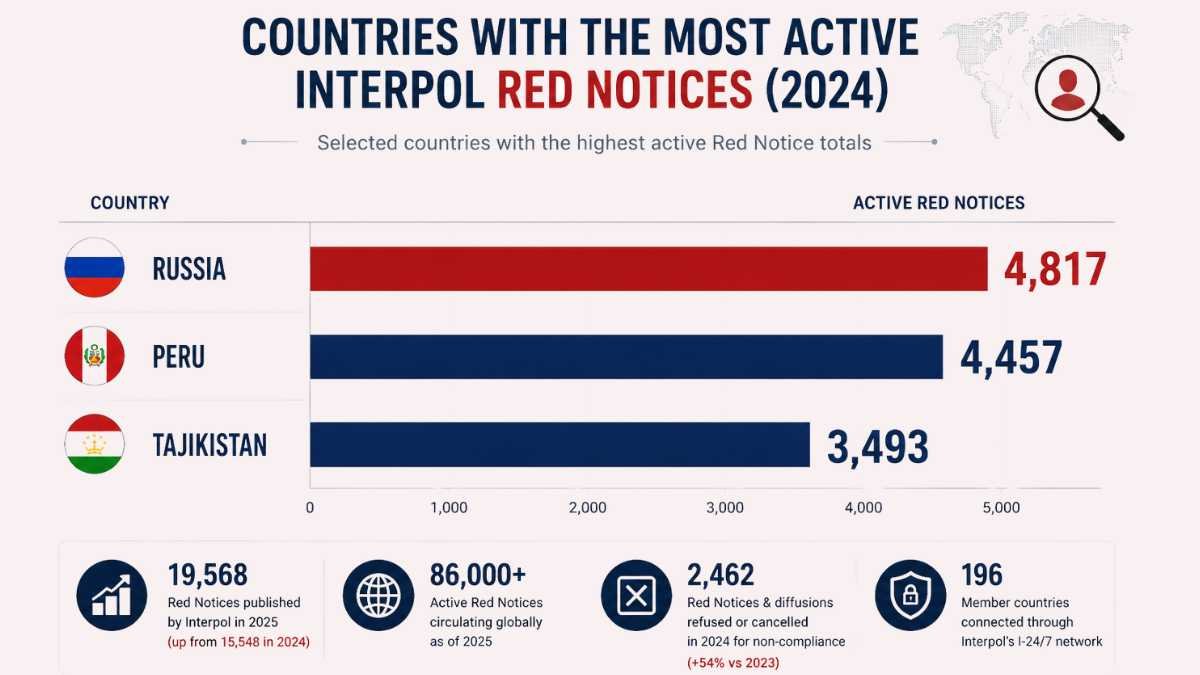
In 2024, Interpol published 15,548 Red Notices, a 27% increase from 2023 and the highest annual total ever recorded.
In 2025, that number rose again to 19,568, according to data from Otherside Law.
And those are just the ones Interpol itself issues; there is also a parallel system called Diffusions: less formal alerts sent directly between national police agencies, bypassing Interpol’s central review process.
These don’t require Interpol’s approval; they’re harder to challenge, and they barely get any public attention.
If I have to break it down by country? So as of September 2024:
- Russia led with 4,817 active Red Notices
- Peru at 4,457
- Tajikistan at 3,493.
Russia’s dominance here is not a new thing; a 2021 study found Russia was responsible for around 38% of all public Red Notices globally.
In 2024 alone, Interpol refused or cancelled 2,462 Red Notices and diffusions for non-compliance, a 54% increase over 2023.
It is also called abuse and is scaling up faster than the review process can handle it.
When the Red Notice Works the Way It’s Supposed To

Between June and December 2025, Interpol coordinated a fugitive operation across Latin America, the Caribbean, and Europe that led to 85 arrests of internationally wanted criminals, including members of MS-13, the Albanian organized crime network, and Tren de Aragua.
- Drug traffickers get caught crossing borders.
- Child sex offenders get flagged at airports.
- War criminals who’ve spent years living comfortably in third countries get located and extradited.
For that kind of work, the Red Notice is irreplaceable, because no other international mechanism does this at scale across 196 countries.
However, catching a murderer in Medellin can also be pointed at a journalist in Berlin, and the system doesn’t always know the difference fast enough.
How Authoritarian Regimes Weaponize It

The playbook is basically the same across different governments:
- Take someone you want to silence (a dissident, a journalist, a former official who knows too much, a business rival)
- And have your domestic judiciary issue charges.
- Corruption works well because it’s vague and hard to immediately disprove.
- Terrorism is useful because it triggers fear responses in other governments.
- Then submit the Red Notice through your NCB and let Interpol’s network do the rest.
After that, the target who is now living in another country will suddenly find their bank accounts frozen, travel documents flagged, and visa applications rejected.
Even if the Notice is eventually overturned, which can take 18 to 24 months through Interpol’s Commission for the Control of Files (CCF), the damage is done.
Nations with the Most Interpol Red Notice Misuse
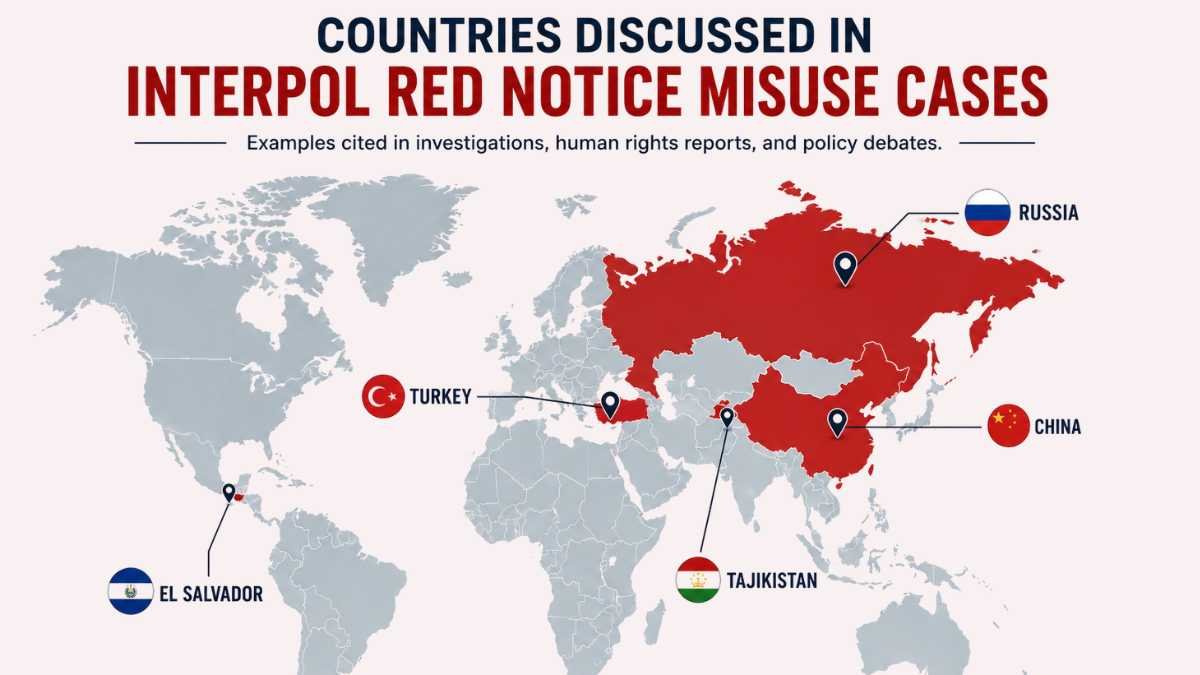
Russia

Russia is the most documented case; a BBC Eye investigation in January 2026, based on leaked Interpol files, revealed Russia using Red Notices and diffusions to pursue critics, journalists, and business figures abroad.
One internal message obtained by the BBC showed Moscow contacting law enforcement in Abu Dhabi after Interpol had denied their Red Notice request, still asking for help locating the target.
That’s explicitly against Interpol’s rules, and it happened anyway.
There’s also the case of Armen Aramyan, a journalist who fled Russia after being convicted of “engaging minors in dangerous activities.”
And the actual charge was covering student protests in support of Alexei Navalny.
He ended up in Germany, and Russia still used Interpol’s channels to try to trace him.
What made this alarming in early 2025 is that the BBC also reported Interpol had dropped some of the heightened monitoring measures it had implemented against Russia following the February 2022 invasion of Ukraine.
Interpol disputed the framing, but the reporting was based on their own internal files.
Turkey
After the failed coup attempt of July 15, 2016, Turkey attempted to upload 60,000 names into Interpol’s notification system at once.
Turkey also tried to issue a Red Notice against journalist Can Dundar, the former editor-in-chief of Cumhuriyet, who had fled to Germany after reporting on government arms shipments.
The Committee to Protect Journalists intervened, and Interpol rejected the request.
But that’s one journalist who had people advocating loudly for him. Most don’t.
China

China runs a more sophisticated operation; rather than crude political charges, Chinese authorities tend to layer financial crimes onto dissidents (corruption, fraud, embezzlement) and pursue not just the individuals but their assets abroad too.
They’ve gone after Uyghur activists, Hong Kong democracy figures, and business owners who refused to play along with state-connected interests.
In 2021, a Uyghur activist was arrested in Morocco on a Chinese-requested Red Notice and remained in custody pending extradition.
The Red Notice Law Journal has documented multiple cases where the Chinese government raised financial charges against individuals in direct retaliation for dissident speech or business decisions that went against state-connected interests.
Tajikistan and El Salvador
Tajikistan is statistically one of the most aggressive users relative to its size.
It’s a small nation that represents 0.12% of the world’s population but had issued 2,528 Red Notices by 2017, accounting for 2.3% of all notices in circulation at the time.
Much of this is aimed at members of the Islamic Renaissance Party, which Tajikistan banned as a terrorist organization in 2015.
El Salvador
In November 2025, UN Special Rapporteurs issued a formal communication directly to Interpol, the first time in history this had happened, flagging El Salvador’s misuse of Red Notices to target two exiled human rights defenders.
The UN experts described it as transnational repression, a violation of Interpol’s own constitutional commitment to uphold the Universal Declaration of Human Rights.
Structural Problem in Interpol

Interpol’s core design creates this vulnerability; it prides itself on political neutrality and doesn’t take sides between member states, which means it cooperates with democracies and authoritarian governments equally, treats a request from Norway the same as one from Belarus.
Okay, so that design principle made sense when the world had clearer lines.
But it makes less sense now, when a state can use “neutrality” as cover for sending politically motivated requests through a respected international institution and get democratic governments to act on them.
The CCF, Interpol’s independent oversight body, does catch and delete abusive notices.
- In 2024, it removed at least 322 notices it deemed unjustified.
- In March 2026, it launched a new dedicated online portal as the only channel for submitting challenges.
But the CCF processes over 2,500 new requests annually with a budget of around 4 million euros and about 15 staff.
Reviews on contested cases routinely take 6 to 18 months.
And Interpol still doesn’t publish country-specific breakdowns on refusals, which makes it impossible for outside researchers or human rights organizations to identify systemic patterns of abuse by individual states.
So this transparency gap is intentional, in my view, and it protects Interpol diplomatically, but it also protects abusive states.
What Happens to the People Targeted

Igor Pestrikov, a Russian dissident mentioned in the BBC’s 2026 investigation, had a diffusion active against him for two years.
- During that time, he couldn’t rent an apartment.
- His bank accounts were frozen.
- He was essentially in financial limbo in a country that had welcomed him as a refugee, because a foreign government had pushed his name through an international police network.
Bahrain used a Red Notice to have a professional soccer player, an outspoken government critic, arrested at Bangkok’s airport in 2018.
He spent two and a half months in a Thai prison before the notice was eventually dropped.
Qatar issued a Red Notice against a Scottish engineer in 2022 over a disputed $5,000 bank loan, and he also spent two months in an Iraqi prison.
However, later, all of these notices were eventually rescinded, but it damaged their reputation, career, etc.
Can You Challenge a Red Notice?

Yes, but it’s a slow and expensive process, which runs through Interpol’s Commission for the Control of Files.
Since March 2026, all requests must be filed through a new dedicated online portal.
Email and postal submissions are no longer accepted.
The first step is an access request, asking Interpol to confirm whether data exists on you and provide details, and it will take 3 to 6 months.
Legal challenges a challenger has to face

Legal challenge requires demonstrating that the notice violates Interpol’s rules, typically Article 3 of its Constitution, which prohibits actions of a political, military, religious, or racial character.
If you’ve been granted asylum or refugee status in a third country, that’s often strong evidence.
If the charges are transparently connected to journalism or political activism, that matters too.
The total timeline from submission to decision will take around 9 to 18 months for contested cases.
So it requires international legal expertise that most people targeted by authoritarian governments can’t afford.
What Reform Looks Like In Interpol
Amnesty International, in January 2026, called on Interpol to be willing to suspend states who misuse their processes.
It was a big thing to ask, and not one Interpol has shown an appetite for.
However, realistic reforms being discussed in policy circles include:
- Mandatory country-specific reporting on notice refusals and cancellations, so patterns of abuse can be tracked publicly
- Proactive review of notices from jurisdictions with documented histories of misuse, rather than waiting for individuals to file challenges
- Faster provisional blocking when a credible human rights concern is raised
- Strict enforcement of the rule against using Interpol’s communication channels to pursue people after a Red Notice has been denied
The US Congress has pushed Interpol on some of this through the TRAP Act, which requires biannual assessments of member country abuse.
But Interpol is an international organization, and congressional pressure only goes so far.
Final Thoughts
Interpol processed more Red Notices in 2024 and 2025 than at any point in its history, and more importantly, this system is growing, but the abuse is growing too; we can’t see reforms; they’re much slower than the number of Red Notices increasing.
However, it also doesn’t mean that Interpol is bad, because for a genuine transnational crime, it’s excellent.
People sometimes raise a valid question that this institution designed for neutral police cooperation can hold that neutrality when member states with authoritarian tendencies have learned exactly how to exploit it.
It’s not being done consistently, but it happens a lot when Interpol is misused.
You can notice this pattern in the BBC’s leaked files, Amnesty International statements, UN Special Rapporteurs flagging El Salvador in November 2025, etc.
And the people most exposed to that pattern are the ones with the least political protection: journalists, dissidents, human rights defenders, and exiles living in foreign nations.
FAQ
If a Red Notice gets deleted, does that automatically clear your name in every country?
Yes! And when Interpol deletes someone’s Red Notice, it also notifies all member countries within 24 hours. It also tells them to remove the information from their national databases.
However, countries don’t always act quickly, and some national databases update more slowly than others.
If you’ve been cleared, you still need formal documentation of the deletion to show at borders.
Don’t assume the system updates automatically across all 196 countries overnight.
Why doesn’t Interpol just ban countries that repeatedly abuse the system?
It’s a central political tension: Interpol’s funding and functioning depend on universal membership.
Suspending a member like Russia or China would create diplomatic fallout, and it may also fracture the cooperation Interpol needs to function for legitimate cases.
The current approach is to screen out individual notices rather than sanction states.
Critics (and I count myself among them when looking at the data) argue this is inadequate given the scale of documented abuse.
Is a diffusion more dangerous than a Red Notice to the person targeted?
In some ways, yes, a Red Notice goes through Interpol’s General Secretariat and can be challenged through the CCF.
On the other hand, a diffusion is sent directly between national police agencies, bypasses central review, and is often confidential, and the person targeted may not even know it exists.
The BBC’s 2026 investigation highlighted this specifically: Russia was using diffusions to pursue people after its Red Notice requests were rejected, and it also exploited the fact that diffusions sit in a grayer legal zone.
Do Red Notices expire?
Yeah, but only if the person was convicted, acquitted, or died; there is no automatic expiration date.
Red Notices are reviewed every five years and taken down if found to be non-compliant.
A notice can stay active indefinitely if the requesting country keeps renewing it and Interpol doesn’t find a compliance issue.
For politically motivated notices, this is part of the problem: a dissident could spend a decade in this limbo.
What’s the difference between a Red Notice being public and what happens at a border?
Most Red Notices are not public; only a small fraction appear on Interpol’s website.
The rest are restricted to law enforcement use, circulated through the I-24/7 secure network that border agencies and immigration services use.
So someone could have an active Red Notice with no public trace, and only find out when they try to board a flight or cross a border and get flagged by systems they can’t see.
How to Check an Interpol Red Notice
It’s not a simple process to search a complete database of Red Notices online, as most notices are not public and are only visible to law enforcement agencies through Interpol’s secure systems.
If your notice has been published, it may appear on Interpol’s website.
Otherwise, targeted people will discover a Red Notice through border checks, visa applications, or by requesting access to information through Interpol’s procedures.
Who Funds INTERPOL the Most?
Interpol is funded by its member states; in addition, they also receive voluntary donations from governments and organizations.
However, some nations like the United States, Germany, Japan, France, and the United Kingdom have been among its largest financial contributors.
The United States is generally regarded as the biggest overall contributor when both assessed and voluntary funding are considered.

Abraham is the founder and sole writer of Geopolitics Decoded. Based in New Delhi, India, he has been researching and analyzing international affairs since 2019, with a focus on great-power competition, European security, energy geopolitics, and global diplomacy. He is currently pursuing independent coursework in global diplomacy through SOAS University of London. His fact-based, deeply contextual analysis has earned millions of interactions across social media platforms, including Threads and Instagram. Every article on this site is independently researched, written, and verified by Abraham personally. Read Abraham’s full author bio