It’s a strange paradox when it comes to Europe defense spending issues, because the budget is decent, and for the first time in over a decade, yet there are issues.
In 2025, all 32 NATO members reached or passed the 2% GDP threshold that had been promised at the 2014 Wales Summit.
European allies and Canada invested $574 billion in defense that year; it’s a 20% increase in real terms over 2024, which is good.
However, spending money and building military capacity are two different things.
NATO members have donated equipment to Ukraine, which stretched their own defense industries past what they were designed for, and at the 2025 NATO Summit in The Hague, they signed up for a new 5% GDP target by 2035 that would require most members to more than double their current spending.
What Donating to Ukraine Did to European Stockpiles

Since 2022, the EU and its member states have provided $82.9 billion in military support to Ukraine, making Europe Ukraine’s largest single backer.
And early waves of that aid, from 2022 through 2024, came largely from existing national inventories; many countries pulled weapons off shelves, out of storage depots, and shipped them east, and those shelves are now emptier.
Research from CEPA found that by 2025 the stockpile model had effectively run dry, and countries were shifting from donating existing equipment to financing new industrial procurement, because the stocks were simply gone.
Countries are now moving away from direct donations entirely; they are funding acquisition straight from manufacturers instead.
So, Why Does This Shift Matter?
It matters because European governments are simultaneously trying to restock their own depleted national inventories and fund new deliveries for Ukraine, from the same defense industries that were not built to run at that kind of volume.
Yes, there is a double demand, but the supply side has not kept pace with either leg of it.
An Industrial Base Built for Peacetime That Is Not Matching Right Now
The defense industries across Europe were, for decades, optimized for peacetime efficiency.
Long procurement cycles, small production runs, minimal raw material stockpiles, just enough factory capacity to meet steady-state orders from governments not expecting to fight anyone.
However, Ukraine exposed that in stark terms: in just the first three months of 2024, Russia produced what NATO collectively produced in an entire calendar year.
- Russia was running at around 250,000 artillery shells per month.
- NATO’s own 2026 production target is 267,000 rounds per month.
That is near-parity with Russia, not superiority, and not the deterrence margin an alliance needs to actually deter anything, and even that parity number is optimistic.
Europe’s ammunition supply chain has hard physical limits

There is a single major TNT producer on the entire continent, located in Poland.
Explosives, propellants, specialized metals, the inputs that artillery shell production requires, cannot be conjured quickly regardless of how much budget gets appropriated.
Lead times on new production facilities run years, not months.
Platform fragmentation also makes this problem worse.
I was reading a McKinsey analysis from February 2026, and it found that European platform fragmentation across defense systems had increased by nearly 10% since 2014.
Countries still prefer buying from domestic suppliers even when joint procurement would be cheaper and faster, because Article 346 of the Treaty on the Functioning of the EU allows member states to bypass procurement rules for national security reasons.
Most of them use that exemption routinely to protect domestic industry, and the result is a continent full of incompatible systems, duplicated R&D, and no economies of scale.
Lack of Skilled Workers Is Big Problem
You can announce a new production line, but can you staff it without the right people? Of course not, so right now those people simply are not available at the scale Europe needs.
Management consulting firm Kearney calculated that just raising European spending from 2% of GDP to 3% would require 760,000 new skilled workers across the continent, and it includes:
- Product developers
- Engineers
- Welders
- Electronics technicians, and more.
Rheinmetall, Europe’s largest ammunition producer, is trying to expand its workforce by 29%, adding up to 9,000 employees by 2028.
Thyssenkrupp Marine Systems needs 1,500 workers for a single shipyard in northern Germany.
A missile and drone engine manufacturer in the Czech Republic raised wages 8% in one year, with another 10% planned, and still cannot find enough qualified applicants.
So, companies are ready to pay, but skilled workers are not available in the numbers required.
And now training them and making them mature will take a decade; Europe has already started those conversations now, which means the workforce benefits will arrive around 2035, which is also when the new NATO spending targets come due.
Germany’s Zeitenwende is Big Promise, but the Delivery is Slow
I don’t see a country that illustrates the gap between stated ambition and actual delivery more clearly than Germany.
When Chancellor Scholz announced the Zeitenwende, his “epochal turnaround,” on February 27, 2022, in the Bundestag, it resonated across the continent, as Germany was finally going to get serious about defense.
- A EUR 100 billion special modernization fund was finalized for the Bundeswehr.
- Defense spending rose from 1.27% of GDP in 2021 to 2.14% in 2025.
- The projected 2026 budget stands at EUR 117.2 billion, with EUR 162 billion penciled in for 2029.
In March 2025, Germany amended its constitutional debt brake to exempt certain defense expenditures.
How about the implementation?
A DGAP research project concluded that the Zeitenwende has effectively failed as a political project, that it no longer carries real political force, and should be retired as a term.
A separate analysis from the US Army War College found that delays in equipment procurement and persistent operational readiness shortfalls continue to undercut German efforts to meet NATO commitments.
Bureaucratic inefficiency and uncertainty about what happens after the special fund expires around 2027 are also central structural problems.
The government under Friedrich Merz is also pushing a significant procurement shift.
Germany’s 2025-2026 procurement plan covers 154 major purchases, with only 8% going to US suppliers, a sharp turn from when Berlin was one of Washington’s largest defense clients.
This intent is to build European industrial capacity, with Rheinmetall and others set to receive enormous order volumes.
Poland Is Playing a Different Game
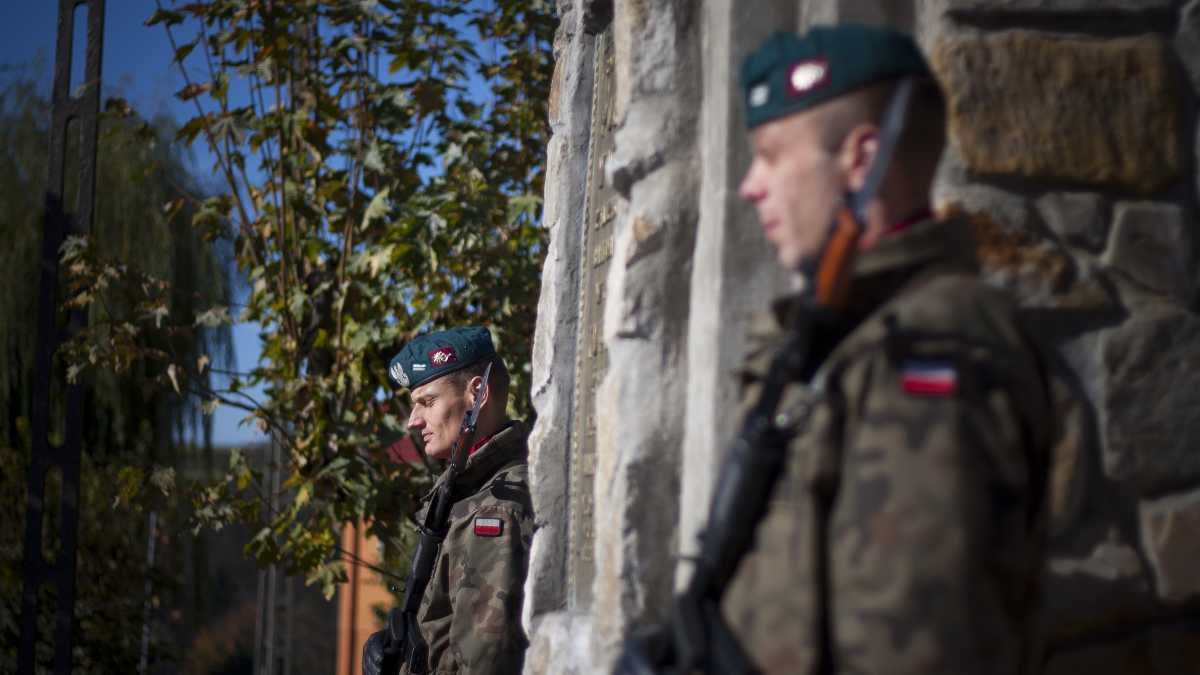
While Germany works through its institutional inertia, Poland also has a big role in NATO, and has been spending aggressively and consistently.
Poland’s defense spending hit 4.5% of GDP in 2025, which is the highest of any NATO member, including the United States, and that is $46.8 billion, a 207% increase from 2016. Warsaw has also set a target of 5% for 2026.
The Polish Deputy Defense Minister said in May 2026 that Poland already possesses the most capable land army in Europe, with a target of a 300,000-strong force.
So this is an extraordinary ambition from a country that was not on most people’s radar as a military power a decade ago.
How is the Polish funding Momentum?
In May 2026, Poland became the first country to receive loans under the EU’s SAFE program, signing for EUR 43.7 billion to fund defense purchases through 2030.
The money is earmarked for:
- Drone capabilities
- AI applications
- Spatial imaging
- Long-range precision munitions.
67% of Poles support further defense budget increases, which gives the government the political room to keep going.
One more important thing is that Poland is spending heavily, but it’s still buying most of its high-end hardware from American manufacturers:
- F-35A fighters
- Abrams tanks
- Patriot batteries
- HIMARS rocket systems, etc.
Warsaw is the alliance’s spending champion, but it is a buyer of capability rather than a producer of it; it might be problematic if Poland ever needs to operate without reliable American supply lines.
NATO’s 5% Target: Is it Commitment or Political Theater?
At the June 2025 Hague Summit, all 32 NATO members except Spain committed to spending 5% of GDP on defense and security by 2035.
The 5% breaks into:
- 3.5% for core defense and
- 1.5% for broader security categories including cyber, critical infrastructure, and civil resilience.
Spain received an exemption and capped its commitment at 2.1% of GDP after friction with Washington.
But can all NATO members really meet the commitment?
SIPRI analysis found that to hit 5%:
- Germany would need to be spending roughly $329 billion by 2035.
- France $221 billion.
- Italy $158 billion, so it needs a 211% increase on current levels.
- Portugal faces a 226% increase.
- The UK has reportedly requested a 3-year delay on the hike.
There is also a 2029 review point built into the commitment; however, I believe that NATO members will arrive at that review considerably short of the trajectory, and the target will be reframed.
Because Europe needs to spend more and build more capacity, but committing to numbers (5%) that require doubling or tripling defense budgets within a decade, across economies facing aging populations, fiscal pressures, and social spending demands, is easier to announce than to execute.
And even if the money were there, the industrial infrastructure to spend it effectively is not yet in place, as I have said earlier about the skilled workers too.
FAQs
Why does Europe struggle to build military capacity even when its defense budgets are rising?
Budgets and capacity are not the same lever; European defense industries spent around three decades being fine-tuned for low-volume, peacetime production: small runs, lean inventories, just-in-time logistics.
So, when governments suddenly double their appropriations, the factories, supply chains, and trained workforces needed to absorb those orders do not appear on the same timeline.
Therefore, money is sitting in the system waiting for infrastructure that does not yet exist at the required scale.
How much has Europe actually given to Ukraine, and has it hurt European readiness?
The EU and its member states have provided $82.9 billion in military support to Ukraine since 2022, the largest donor bloc globally.
A significant share of early deliveries came directly from national military inventories.
By 2025, those inventories were substantially drawn down, and European countries had largely shifted to financing new industrial production rather than donating from stock.
The consequence is a dual burden: European militaries are trying to restock their own depleted arsenals and fund new production for Ukraine, from the same constrained industrial base.
Which European country is actually closest to meeting the new NATO 5% target?
Poland, by a significant margin, was at 4.5% of GDP in 2025 and is now aiming for 5% in 2026; Poland is already at or near the eventual target that most other NATO members are treating as a ten-year ambition.
The Baltic states, particularly Lithuania at 4% and Latvia at 3.6%, are also well ahead.
Germany and France are improving but still have large gaps to close relative to the 5% benchmark.
Southern European members like Italy, Portugal, and Spain are furthest away, with Spain having formally negotiated an exemption from the requirement.

Abraham is the founder and sole writer of Geopolitics Decoded. Based in New Delhi, India, he has been researching and analyzing international affairs since 2019, with a focus on great-power competition, European security, energy geopolitics, and global diplomacy. He is currently pursuing independent coursework in global diplomacy through SOAS University of London. His fact-based, deeply contextual analysis has earned millions of interactions across social media platforms, including Threads and Instagram. Every article on this site is independently researched, written, and verified by Abraham personally. Read Abraham’s full author bio